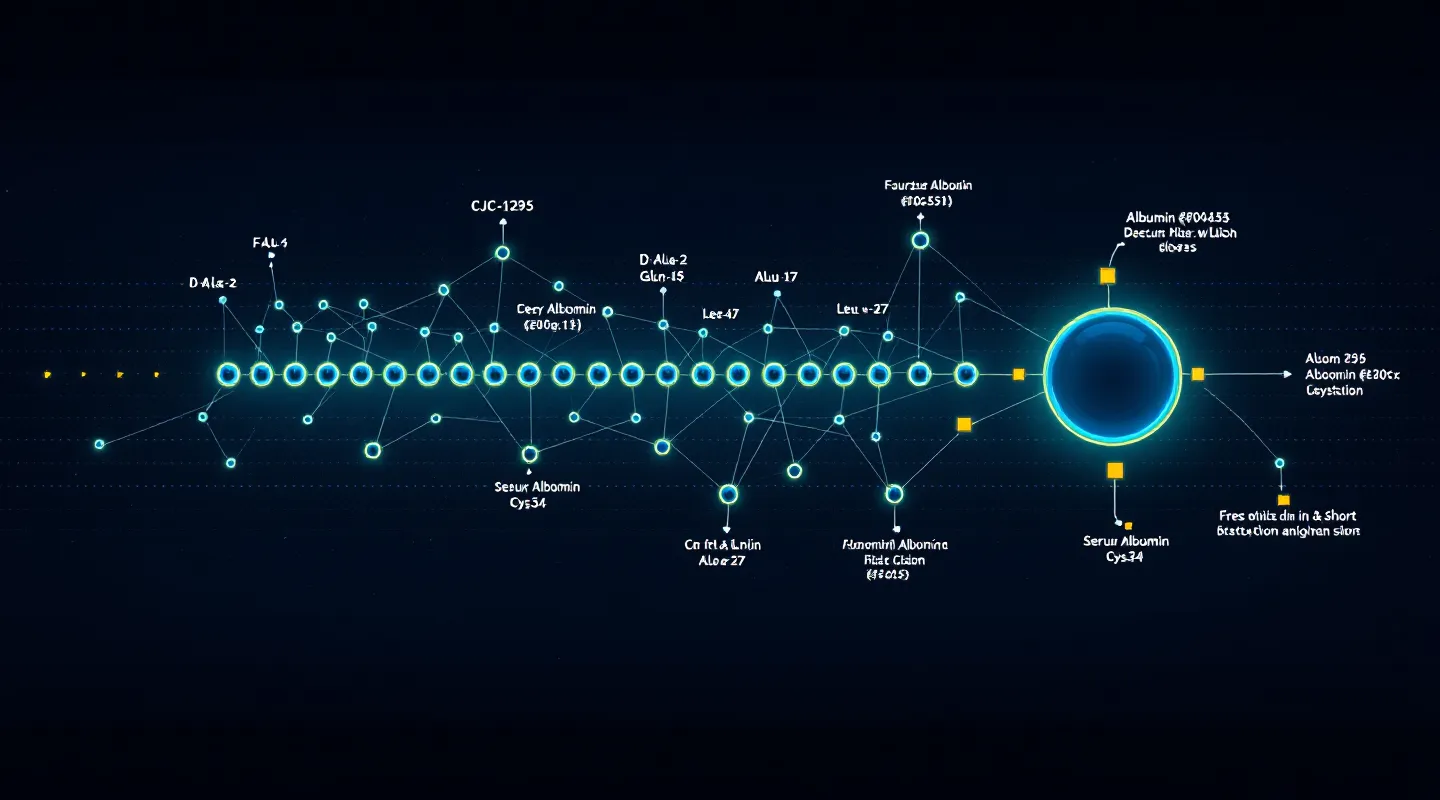
NETWORK MAP / NODE 00 / CJC-1295 DAC
CJC-1295 is a peptide that joins the circulatory mesh instead of passing through it.
Twenty research findings, two human trials, one severed Phase 2 edge, and a five-agency regulatory mesh — read as a connected graph rather than a linear narrative.
The short version
CJC-1295 is a synthetic peptide built on the first 29 residues of human growth-hormone-releasing hormone — the signal your hypothalamus sends to your pituitary to release growth hormone (GH). What makes it unusual is the Drug Affinity Complex (DAC) handle: a small reactive group that, once injected, locks the peptide onto a protein called albumin that floats in your bloodstream for weeks. That bond turns what would otherwise be an eleven-minute molecule into one that keeps working for five to eight days from a single dose.
Two Phase 1 trials in healthy adults confirmed this — one dose raised GH two- to tenfold for almost a week, and IGF-1 (the downstream growth signal) stayed elevated for up to eleven days [2]. A later study showed that normal pulsatile GH secretion was preserved throughout [3]. A Phase 2 program in HIV patients was discontinued and never completed. No regulator has approved CJC-1295 for any use. It is WADA-prohibited at all times in sport.
This site indexes what the published literature actually says about the mechanism, the trials, the detection methods, and the safety questions. It does not sell anything, recommend anything, or connect to any supply chain. For reported community effects and documented cautions, see the effects page.
What CJC-1295 actually is
CJC-1295 is a 30-residue peptide. Its first 29 residues are a tetra-substituted analog of human growth-hormone-releasing hormone — hGRF(1-29) — with four engineered swaps that protect it from the most common proteolytic and oxidative failure modes of native GHRH: D-Ala at position 2 (blocks dipeptidyl peptidase-4 cleavage), Gln at 8 (prevents asparagine rearrangement), Ala at 15 (raises receptor affinity), and Leu at 27 (removes the oxidation-prone methionine) [1].
The thirtieth residue is the engineering that makes CJC-1295 unusual. C-terminal Lys30 carries a maleimidopropionic-acid group — a reactive handle that, once injected subcutaneously, forms an irreversible thioether bond with the free thiol on Cys34 of circulating serum albumin via Michael addition [1]. The peptide does not circulate as a free peptide. It circulates covalently tethered to albumin, regenerated continuously by hepatic albumin turnover, and presented to the pituitary GHRH receptor as a long-lived ligand on a long-lived carrier [1] [2].
The consequence of that single chemistry change is large. Native sermorelin clears with a plasma half-life of roughly eleven to twelve minutes. Modified GRF(1-29) without the DAC handle — what gray-market vendors often label 'CJC-1295 no DAC' — clears in about thirty minutes. CJC-1295 with DAC has an estimated plasma half-life of 5.8 to 8.1 days in healthy humans [2] [16]. That is the entire compound, in one sentence: a GHRH analog roughly ten thousand times longer-lived than its parent.

Why this site exists
The published record on CJC-1295 is small. Two Phase 1 trials in healthy adults, one terminated Phase 2 program, a half-dozen analytical-chemistry papers driven by anti-doping authorities, and a handful of preclinical models. That body of evidence is finite and tractable — but the secondary literature around it (forums, vendor pages, lifestyle medicine sites) routinely overstates, conflates with-DAC and no-DAC variants, or invents human dosing protocols that the trial program never tested.
CJC-1295 / Order is an editorial reading of the primary literature, organized as a network rather than as a long argument. Each finding from the published record is a node. The directed edges between nodes — mechanism feeding trials, trials feeding the regulatory mesh, the regulatory mesh feeding detection methodology — are how the compound's story actually fits together. The reader navigates by following edges, not by scrolling through prose.
The modifier 'order' in this site's domain is editorial framing — the position of structured acquisition that the publisher occupies relative to the literature. The about page expands on the entity question.
What the data shows, in one paragraph
In healthy human volunteers, single subcutaneous CJC-1295 doses between 30 and 250 microgram per kilogram produced mean plasma GH increases of two- to ten-fold sustained for six or more days, IGF-1 increases of 1.5- to threefold sustained for nine to eleven days, and an estimated plasma half-life of 5.8 to 8.1 days [2]. Weekly dosing at 60 microgram per kilogram for 28 to 49 days produced cumulative IGF-1 elevation lasting roughly 28 days [2]. A separate Phase 1 study in healthy men showed that GH pulsatility is preserved under sustained CJC-1295 stimulation: pulse frequency and amplitude did not change, but trough GH rose 7.5-fold and total GH secretion rose 46 percent [3]. The Phase 2 program in HIV-positive patients with visceral lipodystrophy (NCT00267527) enrolled 192 subjects but was halted after a participant cardiac death two hours after the eleventh weekly dose; the event was adjudicated as drug-unrelated, attributed to pre-existing coronary artery disease, and the body-composition endpoints were never published in peer-reviewed literature [11]. No Phase 3 trial has been registered. No regulator has approved CJC-1295 for any indication.
How to read this site
Six content pages branch from this index node.
/research is the central hub — twenty findings rendered as a sortable, filterable network index with status-pulse tags for category (mechanism, clinical, forensic, regulatory) and the inline diagrams that anchor mechanism, the trial graph, and the detection-methods hub.
/effects is the community-signal node — what people in research-use communities report, labeled clearly as anecdotal and not clinical data, alongside documented safety cautions grounded in mechanism and cited literature.
/dosage is the research-context node — what was actually administered in published studies, framed strictly as research administration to named research subjects in published protocols. The page does not provide dosing for any human or non-research use.
/faq consolidates fifteen common questions and reads at slightly warmer cadence than the technical pages.
/references is the full citation graph with DOIs and PubMed/PMC links, filterable by year and venue.
/about documents the publisher entity, editorial method, and disclaimer in plain language.
/contact is a simple message-form node for corrections, citation requests, and editorial correspondence — not for product orders, clinical questions, or vendor relationships.
Together the nodes form one routed reading of the CJC-1295 literature — a reference to navigate, not a service to buy from.